


Discovering Yemayá: The Mother of All Living Things and the Sacred Anchor

A deeper look at Yemayá as the great mother, protector, and oceanic force of emotional depth, fertility, and spiritual nourishment
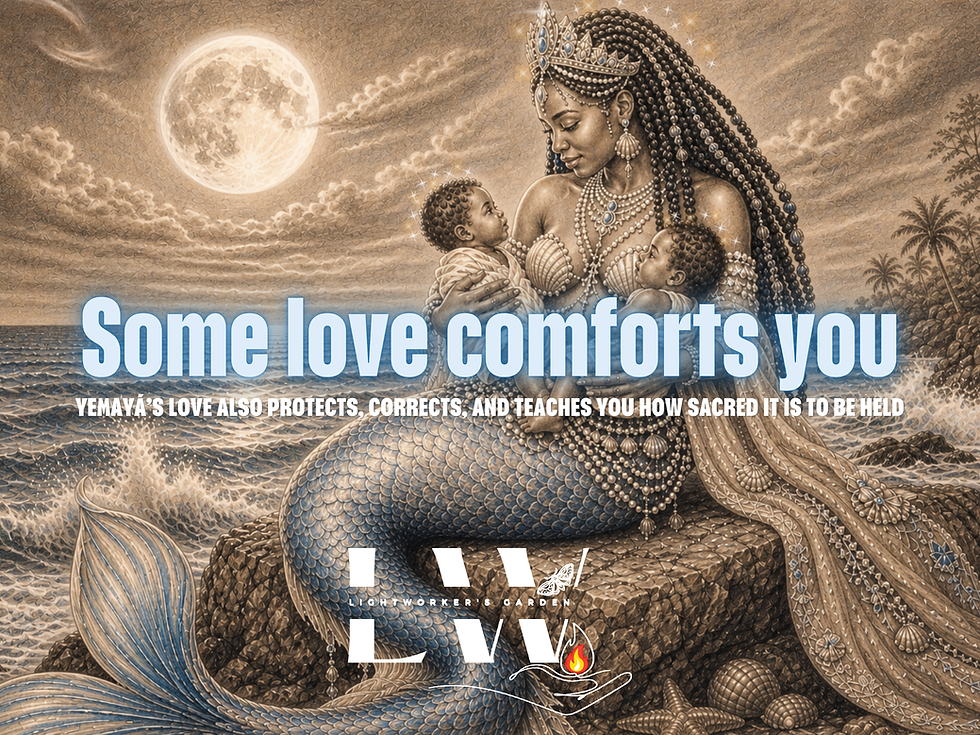
Some divine powers arrive like fire: they confront, they purify, and they force change. Others arrive like water. Discover why Yemayá is the essential, oceanic force that defines the very meaning of sacred protection, unconditional care, and the spiritual power of holding life together.
This article covers:
Who is Yemayá in the Orisha pantheon? Yemayá is one of the most revered divine mothers in Yoruba and Afro-diasporic traditions. She is the Orisha of the ocean, maternity, and emotional wisdom.
What does Yemayá represent? She represents the "mother of all living things," symbolizing fertility, lineage, and the sustaining force of life itself.
What are the symbols and colors of Yemayá? Her symbols include the ocean, seashells, and water vessels. Her colors are blue and white.
How is Yemayá honored in spirituality? She is honored through rituals of reciprocity, such as offering fresh water, white flowers, and melons at the shoreline or in a clean devotional space.
“Some love comforts you. Yemayá’s love also protects you, corrects you, and teaches you how sacred it is to be held.” -- Michele Thompson
The Sacred Reality of the Deep Mother
Some divine powers arrive like fire. They confront. They purify. They force change. Others arrive like water. This is not softness in the weak sense, but softness in the ancient sense. It is the kind of softness that carries weight, memory, grief, nourishment, danger, beauty, and life all at once. It is the kind of power that can rock a child to sleep and still swallow a ship whole if disrespected. This is the presence that comforts, protects, cleanses, and corrects without ever needing to prove its force.
This is Yemayá.
She is often described as the mother of all living things, the mother of the Orishas, the great oceanic force, and the one whose waters carry both love and law.
She is nurturing, yes, but never small.
Protective, yes, but never passive.
Gentle, yes, but never without authority.
To understand Yemayá is to understand that motherhood in its sacred form is not just tenderness. It is containment. Wisdom. Ferocity. Emotional depth. It is the ability to hold life, feed life, and defend life.
The Scale of the Oceanic Consciousness
In Yoruba spirituality and in Afro-diasporic traditions shaped by the Orisha, Yemayá is one of the most beloved divine mothers. She is widely associated with the ocean, maternity, and the sustaining force of life itself. But if we reduce her only to a domestic view of motherhood, we miss her true scale. Yemayá is not merely domestic: she is vast. She is oceanic consciousness. She is the mother who holds memory in her depths and the rhythm of the tides.
Her energy speaks to birth, family, and the kind of care that comes with instinctive knowing. She is the keeper of sacred boundaries and the reminder that love without protection is incomplete. She is especially relevant to anyone who has had to become a safe place for others. This includes literal mothers, but it also includes caregivers, healers, elders, and those doing the difficult work of learning how to create safety after living without enough of it. Yemayá governs not only birth: she governs holding.
The Foundations of Motherhood and Holding
To call Yemayá the mother of all living things is not only to call her fertile. It is to call her foundational. This title points to more than biological motherhood. It points to a cosmic maternal principle: the force that births, holds, nourishes, and emotionally shelters life while it is still vulnerable. In that sense, Yemayá is not only the mother who brings forth.
She is the mother who remains.
That distinction matters. Many people understand the excitement of a new beginning, but far fewer understand the spiritual weight of holding. Yemayá’s motherhood includes the messy, repetitive, unseen labor that comes after the moment of birth. It is the feeding and the watching. It is the instinctive knowing when something is wrong and the vast patience required to contain what is still growing. She honors the divine labor of all those who serve as stabilizing, nourishing presences. This includes the grandmother energy, the ancestral mother line, the protective auntie, and the person learning how to self-mother after years of neglect.
The Ocean as the Living Temple
If the waters of Oshun are fresh, intimate, and flowing, the waters of Yemayá are expansive and deep. The ocean is not just her symbol: it is one of the clearest ways to understand her. The ocean nourishes life, carries mystery, and remembers everything. It can be a mirror of peace or a rising wall of protective force.
This is why the ocean is such a fitting temple for her presence. She teaches that emotional life is deep and sometimes unpredictable. Deep feeling is not always neat, and the heart is not always a calm harbor.
Sometimes the maternal instinct is silent and knowing; other times it rises like a wave when boundaries are crossed.
Yemayá is not sentimental: she is sacred depth. She teaches that you do not shame the sea for being deep: you learn how to respect it.
The Patakis: Wisdom of the Maternal Tides
To truly understand the character of Yemayá, we must look to her Patakis, or sacred stories. These stories are not just myths: they are psychological and spiritual maps that explain how she operates in the world.
One of the most famous stories involves Yemayá as the mother who birthed many of the Orishas. Legend says that when her children were in trouble or when the world was in chaos, she wept so much that her tears became the seven seas. This is more than a poetic image. It teaches us that there is a type of grief that is so expansive it creates a whole new world for others to inhabit. Her tears were not a sign of weakness: they were the source of the Earth's lifeblood.
Another story describes her as a woman of immense dignity who once lived on land.
When she was disrespected or when her boundaries were crossed, she did not stay to argue. She simply walked into the sea and became the ocean itself. This teaches us the lesson of the "Sacred Pivot." Sometimes, the most powerful thing a woman can do when her worth is not recognized is to simply become so vast and so deep that she can no longer be contained by those who do not respect her.
The Spiritual Lessons of the Water
In a world that often glorifies speed and hardness, Yemayá’s medicine is a corrective force. She reminds us that nurturing is not a lesser power. Spiritually, she represents:
Divine Motherhood and Creation: The ability to bring life into the world and sustain it.
Sacred Protection: The fierce instinct to defend what is holy and vulnerable.
Emotional Wisdom: The understanding that feeling deeply is not a dysfunction.
Cleansing and Renewal: The power to wash away grief and restore the spirit.
Strength through Devotion: The power to nourish without vanishing in the process.
Many people have been taught to separate tenderness from strength, as though true protection must always look hard and true softness must be defenseless. Yemayá does not accept that split. She teaches that the wave can soothe and the wave can correct.
For those healing emotional wounds, she teaches that needing safety is not a weakness and wanting to be held is not a sign of spiritual immaturity. These needs belong to life itself.
The Symbology and Adornments of the Deep
Yemayá is commonly associated with specific items that reflect her nature. These are not decorative by accident: they reflect her spiritual atmosphere.
The Ocean and Seashells: Representing the sea and protection through enclosure.
Fish and Boats: Representing passage, safe crossing, and the abundance of the depths.
Water Vessels and Fans: Representing nourishment, cleansing, and the movement of energy.
The Moon: Reflecting her tidal, feminine, and cyclical rhythms.
Her colors are blue and white, especially shades that reflect sea foam and ocean depth. Blue reflects emotional vastness, while white reflects purity, peace, and maternal sacredness. Her sacred number is most commonly 7 in many devotional contexts.
These correspondences give the reader a clearer framework for understanding her dignified and shelter-giving presence.
Reciprocity and the Spirit of Offerings
Offerings to Yemayá should reflect respect, gratitude, purity, and care. They are not transactional objects: they are gestures of reciprocity and relationship. Rushed or careless gestures miss the point. She is a mothering force, but sacred motherhood is not casual and deserves dignity.
Commonly associated offerings include:
Fresh Water and White Flowers: Symbols of purity and devotion.
Coconut and Melons: Representing sweetness and fertility.
Rice Dishes: Offering sustenance and physical anchoring.
Molasses: Often used in certain traditions to represent the "sweetness" that stays thick and grounded even in deep water.
Sea-Themed Items: Reflecting her connection to her oceanic home.
What matters most is not only the item, but the spirit in which it is given. Yemayá is approached through cleanliness and emotional truth. She honors the spirit of the giver who approaches with a sincere heart.
Connecting with Yemayá: A Step-by-Step Home Ritual
If you feel called to her oceanic depth, you do not need to be by the sea to connect with her. You can create a "Living Temple" in your own home using simple, respectful elements.
Prepare the Space: Clean a small table or shelf. Cleanliness is a form of respect in the Orisha tradition.
The Water Vessel: Place a clean glass bowl filled with fresh, cool water in the center. This acts as a physical conduit for her energy.
Add the Light: Light a white candle. As you do, state your intention clearly. You might say: "Yemayá, Mother of All, I honor your depth and your protection."
Offer the Scent: If you have white flowers (like lilies or white roses), place them near the water.
The Prayer of the Heart: Speak to her as you would a revered mother. Do not perform: be honest. If you are struggling to hold things together, tell her. If you are celebrating a win, share that too.
The Quiet Listen: Spend a few minutes in silence near the water. Notice the feeling in the room. Yemayá often speaks through a sense of sudden calm or a "sigh" in the atmosphere.
Why Yemayá Matters So Deeply Now
Yemayá matters because the world is emotionally starved. People are overworked, underheld, overstimulated, and often expected to produce through exhaustion while still pretending they are fine. In that landscape, a divine force like Yemayá is not decorative: she is corrective. She reminds us that support is sacred. That care is not extra. That protection is not paranoia. That emotional depth is not dysfunction. That life needs holding, not only managing.
She teaches that before beauty can flourish, there must be shelter. Before abundance can be enjoyed, there must be stability. Before life can bloom fully, it must know what holds it. She is the reminder that the one who holds is just as sacred as the one who shines.
FAQ
Q: Who is Yemayá in the Orisha pantheon?
A: She is the Orisha associated with the ocean, motherhood, protection, and the sustaining power of sacred care.
Q: What does Yemayá represent spiritually?
A: She represents divine motherhood, emotional wisdom, safe holding, and the power of love that defends life.
Q: What are the primary symbols of Yemayá?
A: Her symbols include the ocean, seashells, waves, water vessels, and imagery connected to tides and maternal presence.
Q: What are the colors and numbers associated with her?
A: Yemayá is most commonly associated with blue and white and the number 7, though traditions can vary by lineage.
Q: How can a beginner begin to honor Yemayá respectfully?
A: A beginner can start by learning her stories, offering fresh water or flowers prayerfully, and reflecting on themes of protection and self-mothering.
Q: Is Yemayá the same as the Virgin Mary?
A: In many Afro-diasporic traditions, Yemayá was syncretized with the Virgin Mary (specifically Our Lady of Regla) to allow practitioners to maintain their traditions in secret. While they share the "Mother" archetype, Yemayá remains a distinct Orisha with her own unique history and power.
Praxis Bridge
Understanding Yemayá as an idea is the first step: living her lesson is the goal. Yemayá asks if you are willing to build your life around the truths of protection and care. She asks whether you are willing to become honest about what needs holding, what needs cleansing, and where your own spirit aches for nourishment.
This is spiritual praxis. It is not only about reaching for more: it is about learning how to hold what already exists with greater love, wisdom, and dignity. To learn more about how to bring this "Sacred Structure" into your daily life without triggering burnout, visit our guide on using practical metaphysical tools for stability.
Closing Reflection
Yemayá is easy to call "mother," but she is deeper to understand. Sacred motherhood is not just affection: it is labor, vigilance, memory, and shelter. It is the strength to nourish without vanishing. It is the instinct to defend what is holy and vulnerable. She teaches that the waters of life are not only beautiful: they are responsible. They carry what would otherwise break apart. Somewhere inside, the world knows it needs that kind of water. The kind that does not flatter: the kind that holds.


