


Celtic Ogham Symbols: The Ancient Tree Alphabet and the Spiritual Language of the Druids
- Michele Thompson

- Mar 19
- 10 min read

The Ogham Alphabet Was Never Just a Writing System — It Was a Map of Nature, Memory, and Sacred Knowledge
Long before modern alphabets became standardized across Europe, the Celtic peoples of Ireland and Britain developed a unique script known as Ogham.
Carved into standing stones and wooden staffs, this mysterious alphabet was composed of simple lines etched along a central stem. At first glance, the marks appear almost primitive.
But beneath their simplicity lies something profound.
Each Ogham symbol is associated with a tree, plant, or natural force, linking language directly to the rhythms of the natural world. For the Druids and Celtic scholars who preserved this knowledge, Ogham was not merely a method of recording names or territory.
It was a system of spiritual correspondence—a way of understanding the relationship between human life, nature, and the cycles of time.
Today, the Ogham symbols continue to fascinate historians, spiritual practitioners, and those drawn to Celtic traditions. They remind us that language itself once served as a bridge between knowledge, nature, and spiritual awareness.
This Article Directly Answers
• What are Celtic Ogham symbols?
• What was the Ogham alphabet used for?
• Are Ogham symbols connected to trees and nature?
• Did the Druids create the Ogham alphabet?
• How many Ogham symbols exist?
• How are Ogham symbols used in modern spiritual practice?
• What is the meaning of the Celtic Tree Alphabet?
What Is Ogham?
Ogham (pronounced OH-am) is an early Irish alphabet believed to have emerged around the 4th century CE.
It consists of a series of straight lines and notches carved along a central stem line, usually etched along the edges of upright stones. Archaeologists have discovered over 400 Ogham stones, primarily in Ireland but also in parts of Wales, Scotland, and western Britain.
Most surviving inscriptions are believed to record names, territories, or tribal lineage, often marking land ownership or memorializing individuals.
But historical evidence suggests Ogham may have served a deeper purpose beyond simple communication.
Early medieval texts associate Ogham with druidic knowledge, poetry, and spiritual symbolism, hinting that the system may have carried layers of meaning understood only by trained scholars and spiritual leaders.
Over time, later interpretations connected each Ogham symbol to a specific sacred tree, transforming the alphabet into something much more than a writing system.
It became a symbolic map of the forest itself.
The Complete Celtic Ogham Tree Alphabet
In Celtic tradition, trees were not simply plants. They were seen as living beings carrying wisdom, protection, and spiritual power.
Sacred groves served as gathering places for ceremony, teaching, and decision-making.
The druids—often described as scholars, judges, and spiritual leaders—held deep reverence for forests and the knowledge they represented.
The Ogham alphabet traditionally contains twenty primary letters, grouped into four sets called Aicmí. Each symbol is formed from a series of lines or notches branching from a central stem line. Over time, each letter became associated with a tree or plant and a deeper symbolic meaning.
Together, these symbols formed a spiritual language of the forest, reflecting how the Celts understood nature as a source of wisdom and guidance.
Below is the full traditional Ogham tree alphabet with commonly accepted meanings.

Birch – Beith (B)
Symbolism: New beginnings, renewal, purification
Birch trees are among the first to grow after forest fires or environmental disturbance. Because of this resilience, the Celts associated birch with fresh starts, cleansing, and new opportunities. In spiritual practice, birch represents the courage to begin again.
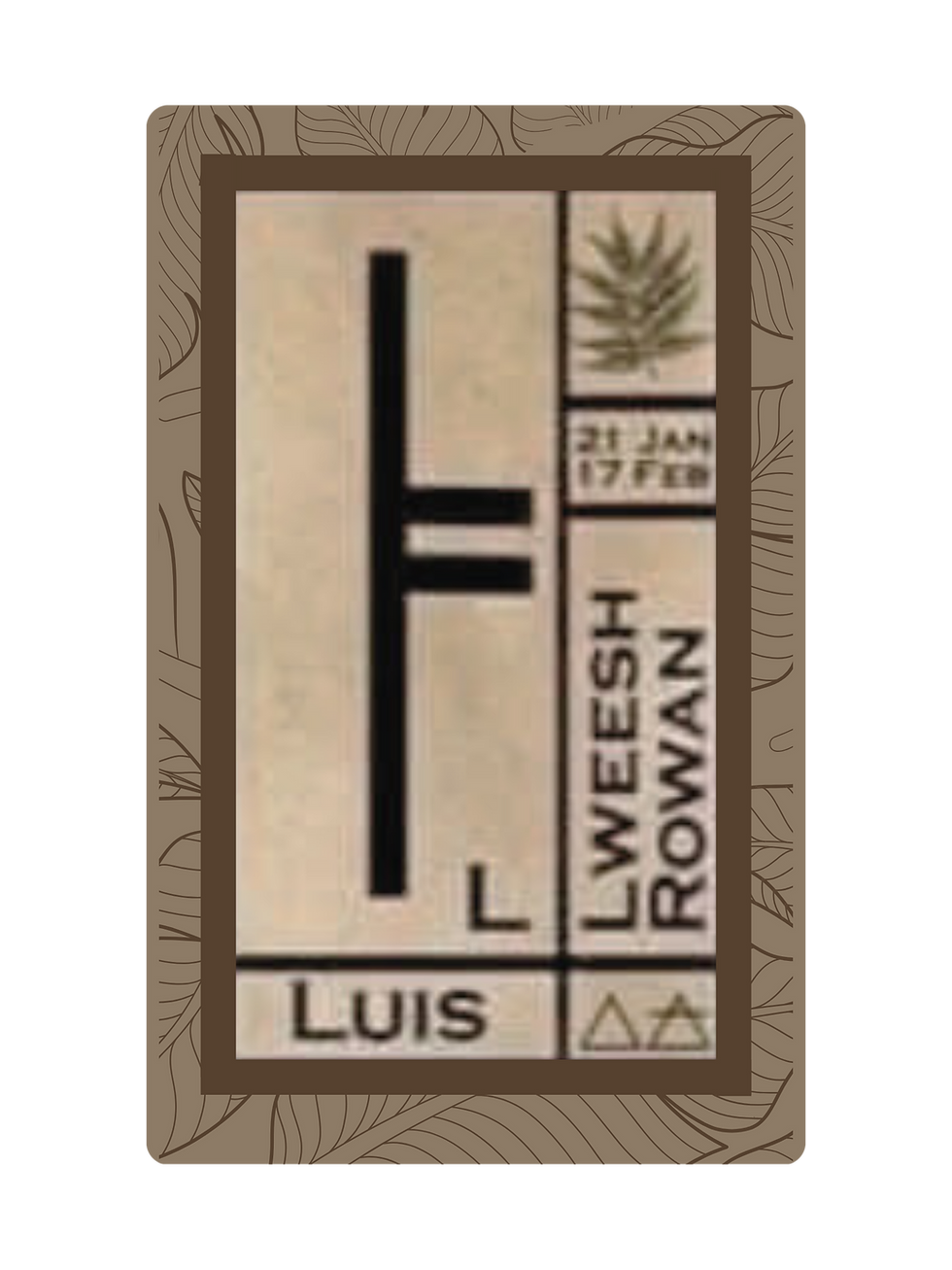
Rowan – Luis (L)
Symbolism: Protection, insight, spiritual awareness
Rowan trees were believed to offer protection against negative energies. In Celtic folklore, rowan branches were often placed near doorways or worn as amulets. Spiritually, rowan represents intuition and energetic protection.

Alder – Fearn (F)
Symbolism: Strength through transition
Alder trees grow along riverbanks, thriving where land meets water. This unique environment made alder a symbol of emotional balance, adaptability, and navigating life’s changes.

Willow – Saille (S)
Symbolism: Intuition, emotional awareness, moon energy
Willow trees bend easily with the wind and are closely associated with water and the moon. They symbolize deep intuition, inner reflection, and emotional wisdom.

Ash – Nion (N)
Symbolism: Connection between worlds
Ash trees appear frequently in mythological traditions across Europe. In Celtic symbolism, ash represents the bridge between heaven, earth, and the spiritual realms.

Hawthorn – Huath (H)
Symbolism: Transformation and thresholds
Hawthorn trees bloom beautifully but carry sharp thorns, symbolizing the dual nature of transformation. In Celtic folklore, hawthorn groves were often considered gateways between the physical and spirit worlds.

Oak – Duir (D)
Symbolism: Strength, endurance, sacred wisdom
Oak was one of the most revered trees in Celtic culture. It symbolizes authority, stability, and spiritual knowledge. Many scholars believe the word druid may derive from an ancient term meaning “oak-knower.”

Holly – Tinne (T)
Symbolism: Protection and resilience
Holly trees remain green throughout the winter, representing endurance and protection during difficult seasons. In Celtic mythology, holly is associated with guardianship and spiritual strength.

Hazel – Coll (C)
Symbolism: Wisdom and inspiration
Hazel trees were connected with knowledge and poetic inspiration. Celtic myth tells of sacred hazel trees whose nuts granted wisdom to those who consumed them.

Apple – Quert (Q)
Symbolism: Healing, abundance, and love
Apples held deep significance in Celtic mythology and were associated with fertility, healing, and the Otherworld. Apple orchards symbolized both nourishment and mystical connection.

Vine – Muin (M)
Symbolism: Insight, prophecy, inner vision
Vine represents clarity of mind and the unfolding of spiritual awareness. It is also linked with celebration, creativity, and poetic inspiration.

Ivy – Gort (G)
Symbolism: Persistence and growth
Ivy climbs steadily and adapts to its surroundings. Spiritually, it symbolizes perseverance, resilience, and the ability to thrive through challenges.

Reed – Ngetal (NG)
Symbolism: Communication and clarity
Reed grows in wetlands and has long been used to make writing tools and musical instruments. It represents expression, communication, and sharing wisdom.

Blackthorn – Straif (Z)
Symbolism: Challenge and transformation
Blackthorn trees carry sharp thorns and bloom early in spring. They symbolize overcoming obstacles and emerging stronger through adversity.

Elder – Ruis (R)
Symbolism: Endings and renewal
Elder trees were associated with cycles of death and rebirth. In spiritual symbolism, elder represents closure, transformation, and new beginnings.

Silver Fir – Ailm (A)
Symbolism: Perspective and higher awareness
Silver fir trees grow tall and straight, symbolizing clarity, resilience, and seeing life from a broader perspective.

Gorse – Onn (O)
Symbolism: Optimism and light
Gorse produces bright yellow flowers even in harsh conditions. It represents hope, resilience, and the persistence of light during dark times.

Heather – Ur (U)
Symbolism: Healing and good fortune
Heather has long been associated with protection, healing, and positive energy in Celtic tradition.

Aspen – Eadha (E)
Symbolism: Courage and sensitivity
Aspen leaves tremble even in gentle wind, reminding us of awareness, sensitivity, and emotional intelligence.

Yew – Iodhadh (I)
Symbolism: Eternity and spiritual transformation
Yew trees can live for thousands of years and were often planted in sacred spaces. They represent eternal life, spiritual evolution, and the cycles of existence.
How Druids May Have Used Ogham
Direct historical evidence of Druidic use of Ogham is limited, largely because Druidic knowledge was traditionally transmitted orally rather than written down.
However, medieval manuscripts such as the Auraicept na n-Éces (The Scholar’s Primer) describe Ogham as a system associated with scholars, poets, and spiritual leaders.
Possible uses may have included:
• recording genealogies
• symbolic teaching tools
• poetic structure and storytelling
• spiritual reflection through tree symbolism
Some scholars also suggest that carved sticks or branches bearing Ogham symbols may have been used for divination practices, similar to the way runes were cast in Norse traditions.
While definitive proof remains debated, the spiritual symbolism embedded in the tree associations continues to resonate with modern practitioners.
Ogham and Modern Spiritual Practice
Today, many people exploring Celtic spirituality have begun to reconnect with Ogham as a tool for reflection and insight.
Modern interpretations often use Ogham oracle sets, where each symbol corresponds to the qualities of its associated tree.
Rather than predicting the future, these symbols can be used as prompts for meditation or journaling.
For example:
Drawing the Birch symbol may encourage someone to consider where they need a fresh start.
Encountering Willow might invite deeper reflection on intuition.
In this way, Ogham functions much like other symbolic systems explored in the Lightworkers Garden blog, including pendulum work and intuitive tools discussed in our article on Scrying Explained: Water, Mirror, and Candle Gazing for Intuitive Insight.
Each system provides a different language for understanding inner awareness.
The Spiritual Meaning of Trees in Celtic Tradition
To truly understand Ogham, we must understand the Celtic relationship with forests.
In many ancient cultures, sacred knowledge was often tied to temples or written texts.
For the Celts, however, the forest itself served as a living temple.
Trees marked seasonal cycles, sheltered wildlife, and provided materials for tools, homes, and ceremonial objects.
This relationship fostered a worldview in which nature was not separate from spirituality—it was its foundation.
Each tree symbolized different aspects of life:
• growth
• protection
• transformation
• endurance
• intuition
Together, they formed a symbolic ecosystem of wisdom.
Rediscovering the Language of the Forest
Modern life often encourages us to look for answers in complex systems, endless information, or technological solutions.
Ancient traditions like Ogham remind us that wisdom can also emerge from something much simpler.
Observing the natural world.
Noticing seasonal shifts.
Spending time beneath trees that have stood for centuries.
The Celts did not separate spiritual insight from daily life.
It was woven into the land itself.
FAQ: Celtic Ogham Symbols
What are Celtic Ogham symbols?
Ogham symbols form an ancient alphabet used primarily in early medieval Ireland and parts of Britain between the 4th and 9th centuries. The script consists of straight lines carved along a central stem line, often found on standing stones marking names, territories, or memorial inscriptions.
Is Ogham the same as runes?
No. While both systems use carved symbols and may have been used for symbolic interpretation, Ogham developed in Celtic regions, while runes originated in Germanic and Norse cultures.
Was Ogham really used by druids?
Some later manuscripts connect Ogham to Druidic teaching traditions, though much of the original Druidic knowledge was transmitted orally. Scholars continue to debate the exact relationship.
How many Ogham symbols are there?
The traditional Ogham alphabet contains twenty primary characters, arranged in four groups of five letters each. Later manuscripts added additional symbols known as forfeda, expanding the system.
Are Ogham symbols used today?
Today, Ogham symbols appear in modern Celtic spirituality, divination systems, and artistic designs. Some practitioners use them for meditation, journaling prompts, or symbolic reflection on personal growth and seasonal cycles.
“The forest was the Celtic library, and every tree carried a letter of wisdom.” -- Michele Thompson
3 Ways to Practice Ogham Wisdom Today
Ancient systems like the Ogham tree alphabet were never meant to remain purely theoretical. They were lived, experienced, and observed through the rhythms of nature itself.
If you’re curious about bringing Ogham wisdom into your daily spiritual practice, here are three simple ways to begin.
1. Spend Time With a Sacred Tree
If possible, take a walk in nature and notice the trees around you. Even if you don’t have access to the exact species listed in the Ogham alphabet, the act of observing trees—how they grow, bend, and endure—can offer powerful insight.
Sit quietly for a few minutes and ask yourself:
What qualities does this tree represent? What might it be teaching me right now?
This practice reconnects us to the Celtic idea that the forest itself can be a teacher.
2. Choose a Tree Symbol for Reflection
Another way to explore Ogham is by selecting one tree symbol and reflecting on its meaning throughout the day.
For example:
Birch may invite you to consider where a fresh start is needed.
Oak may encourage you to stand firmly in your strength.
Willow may remind you to trust your intuition.
Write the symbol in a journal or sketch it on a small piece of paper as a reminder of the qualities you want to embody.
3. Observe the Seasons
One of the most important lessons of the Ogham system is that nature moves in cycles.
Trees grow, shed leaves, rest, and begin again. Observing these seasonal shifts can provide a powerful perspective for our own lives.
As we move through the changing seasons—such as the Spring Equinox, when light and darkness briefly balance—these natural rhythms invite us to reflect on our own cycles of growth, rest, and renewal.
The 20 Ogham Symbols at a Glance
A Quick Reference to the Celtic Tree Alphabet
While each Ogham symbol carries rich mythology and deeper meaning, it can also be helpful to view the alphabet as a complete system. The table below provides a quick reference to the twenty primary Ogham letters, their associated trees or plants, and the core spiritual themes they represent.
The Ogham alphabet, often referred to as the "Celtic Tree Alphabet," consists of 20 original letters (called feda), which are divided into four groups of five. While the historical Ogham was primarily a writing system for the Primitive Irish language, modern Neopagan traditions (largely influenced by Robert Graves' The White Goddess) have assigned specific lunar months and dates to these trees.
It is important to note that these dates are a modern reconstruction and not found in ancient archaeological records.

A Gentle Reminder
Exploring Ogham does not require elaborate rituals or specialized tools.
Sometimes the most meaningful spiritual insights come from something as simple as standing quietly beneath a tree and paying attention.
And that practice reflects a guiding principle we return to often here at Lightworkers Garden: Less Talk. More Praxis.
The Praxis Bridge
At Lightworkers Garden, we often return to a guiding phrase:
Ancient knowledge systems like Ogham remind us that wisdom was never meant to remain purely intellectual.
The Druids and Celtic scholars who preserved these symbols understood something modern culture sometimes forgets: knowledge becomes meaningful when it connects to lived experience.
Learning the meanings of Ogham symbols can become more than a historical curiosity.
It can become a practice.
You might reflect on the qualities of the oak for strength, the birch for new beginnings, or the yew for transformation. These symbols can serve as reminders of how human life continues to mirror the natural world.
In this way, the Ogham alphabet becomes not only a record of the past but also a tool for present awareness.
Closing Reflection
The carved Ogham stones scattered across Ireland and Britain have stood quietly for centuries.
Weathered by wind and rain, their markings remain simple and enduring.
Yet those marks carry an important reminder.
The earliest systems of knowledge were not designed to dominate nature but to understand it.
The Ogham alphabet reflects a worldview in which trees, seasons, and landscapes were not merely resources—they were teachers.
In a modern world that often feels disconnected from those rhythms, the Ogham symbols offer a quiet invitation:
Look to the forests.
Observe the cycles.
Remember that wisdom has always been rooted in the natural world.


